
Generative AI
Neural Networks
Prompt Engineering
Text Generation
Machine Learning
Large Language Models
Transformers
AI Applications
Ethical AI
Digital Literacy
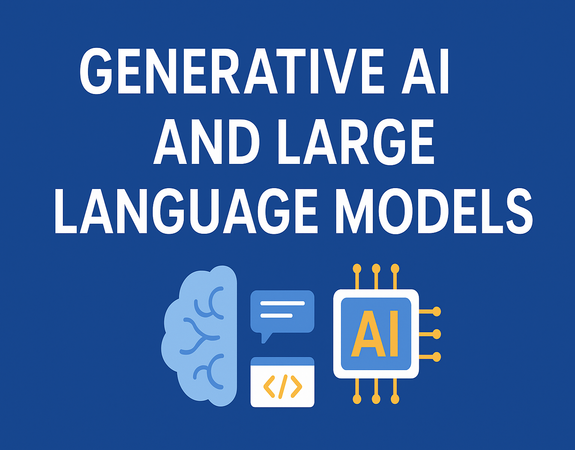
Generative AI has become one of the most transformative technologies of the decade, powering intelligent systems that create text, images, music, code, and even synthetic data. Large Language Models (LLMs) like GPT, PaLM, LLaMA, and others have reshaped industries by enabling natural conversation, automated content creation, decision support, and creativity at scale.
This course, Generative AI and Large Language Models, is designed for learners and professionals who want to understand how these systems work and how they can be applied responsibly and effectively. Whether you're a student, entrepreneur, IT professional, educator, or digital enthusiast, this course provides the foundational knowledge and hands-on experience required to use and integrate generative technologies in real-world contexts.
COURSE OVERVIEW
1. Foundations of Generative AI
Learners begin with core AI and machine learning concepts, focusing on how generative models differ from traditional AI systems. They explore key architectures, data-driven learning, and generative vs discriminative models.
2. Understanding Neural Networks and Deep Learning
This module covers:
Neural network fundamentals
Activation functions
Forward and backward propagation
Deep learning architectures
Students understand how complex patterns are learned and generated.
3. Introduction to Large Language Models
Learners explore:
What LLMs are
How they are trained
How they generate text
Tokenization and embeddings
Model architecture basics
This builds the foundation for understanding GPT-like systems.
4. Transformers and Attention Mechanisms
The Transformer model revolutionized AI with its “attention” mechanism.
Learners study:
How self-attention works
Why transformers replaced older RNN/LSTM architectures
Multi-head attention
Encoder-decoder vs decoder-only transformers
This section is crucial for understanding modern LLMs.
5. Prompt Engineering and Interaction with LLMs
Learners develop practical skills in:
Instruction-based prompting
Using system prompts
Multi-step prompting
Chain-of-thought prompting
Error reduction strategies
Responsible prompt design
This is highly hands-on and essential for real-world AI usage.
6. Generative AI Modalities
Generative AI extends beyond text. Students explore:
Image generation (Diffusion, GANs)
Audio and music generation
Code generation
Video synthesis
Synthetic data generation
Practical workflows are demonstrated using common tools.
7. Applications of Generative AI
Learners examine how organizations use AI in:
Marketing & content creation
Customer service automation
Education
Finance & analytics
Healthcare & diagnostics
Entertainment & design
Software development
Case studies show both opportunities and limitations.
8. Risks, Challenges, and Ethical Considerations
Learners analyze:
AI hallucinations
Bias & fairness issues
Security and misuse risks
Intellectual property challenges
Privacy concerns
Environmental cost of training
Guidelines for responsible AI usage are emphasized.
9. Hands-On AI Projects
Learners perform guided exercises:
Text generation tasks
Summarization & rewriting
Creating AI-generated images
Building small chatbots
Using APIs to integrate LLMs into applications
The focus is on skill-building and practical workflows.
10. Future of Generative AI
The course concludes with discussions on:
Multimodal LLMs
Autonomous agents
AI augmentation in workplaces
AI copilots
Emerging regulation
Learners explore how AI will continue to evolve and impact global industries.
0 Reviews
Corporate Training





Adithya Chiranjeevi K S
hi